

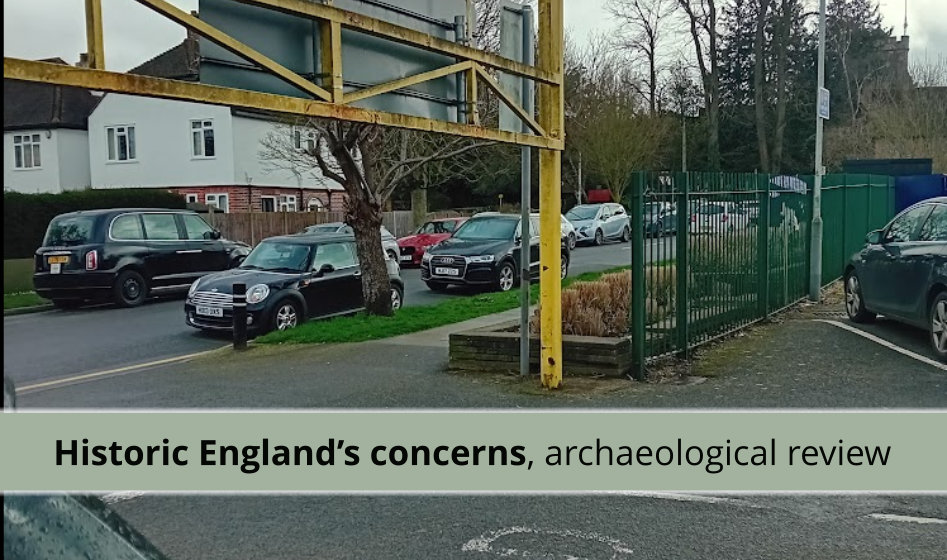
The Ruislip Residents’ Association has formally requested a management review of the St Martin’s Car Park development, citing serious procedural failings and a lack of evidence regarding heritage and traffic safety. This follows a critical report from Historic England’s Greater London Archaeological Advisory Service (GLAAS) warning that the application should be refused unless urgent archaeological field evaluations are conducted.
The two letters below were sent on 10th March to Hillingdon Council by Graham Bartram (RRA Chairman) and Sue Browne (RRA Planning). The letter that both refer to from GLAAS is here.
Some residents have arranged a petition against the St Martin’s CAB planning application. The petition urges the Council to refuse this application because its out-of-character massing fails to preserve the Ruislip Village Conservation Area and visually harms historic assets like Manor Farm. Furthermore, realigning the car park entrance near the busy Eastcote Road junction creates significant highway safety risks. The petition also says that the development will worsen local congestion by severely reducing existing public parking while adding new residential parking demands. Sign online
Request for Management Review – Planning Ref: 49461/APP/2025/3009 St Martin’s Car Park & Former CAB Site, Ruislip
Dear Julia Johnson & Noel Kelly,
I am writing to request a formal management review of the handling of planning application 49461/APP/2025/3009, due to significant concerns regarding procedural robustness, evidential adequacy, statutory consultation, heritage impact, transport safety, and community harm. These concerns are now reinforced by the detailed response from the Greater London Archaeological Advisory Service (GLAAS) dated 9 March 2026 (attached).
Serious Issues Identified by GLAAS
GLAAS identifies fundamental deficiencies in the applicant’s heritage and archaeological submissions, including:
- The site lies between two nationally significant medieval assets, within 100m of both.
- The Heritage Statement and Desk‑Based Assessment are described as “rudimentary” and failing to follow required Historic England methodology.
- Key sources (RCHME 1937; Schofield 2011) were omitted.
- The DBA contains internal contradictions, acknowledging “moderate to high potential” for medieval remains while asserting – without justification – that such remains would be of “low significance.”
- GLAAS confirms that the south site may contain remains associated with a scheduled monument.
Crucially, GLAAS states:
“If you do not receive more archaeological information before you take a planning decision, I recommend that you include the applicant’s failure to submit that as a reason for refusal.”
This confirms the application is not decision‑ready and that proceeding without pre‑determination evaluation would be unsound.
Procedural and Administrative Concerns
A number of process issues require senior oversight:
- The application was validated on 2 December, yet consultation did not begin until 2 January.
- Despite the site’s heritage sensitivity, GLAAS/Historic England were not consulted until 20 February.
- The original Archaeological Desk‑Based Assessment could not be opened on the portal; it is no longer visible on the portal since a revised version dated 18 February was uploaded mid‑consultation without explanation.
- The original Design & Access Statement contained factual errors and omissions.
- Documents uploaded on the portal on dated 4 and 5 March were presented by a local resident to planning – the redacted document highlights incorrect assumptions made in the applicant’s Transport Assessment documents regarding existing parking numbers and bay sizes, and proposed bays that are below standard size.
- Numerous documents have been superseded or replaced, creating confusion and undermining transparency. These include amended site plans, parking layouts, and transport notes visible on the planning portal .
These issues raise concerns about document control, validation, and the ability of residents and consultees to meaningfully engage.
Request for Management Review
Given the seriousness of the issues above, I request that this application be escalated for formal management review, with the following objectives:
- To ensure the application is assessed in accordance with the NPPF, London Plan, and Local Plan.
- To confirm whether statutory consultation and validation processes were correctly followed.
- To ensure that the deficiencies identified by GLAAS are fully addressed before any recommendation is made.
- To assess the community, accessibility, and transport impacts that have not been properly considered.
- To restore public confidence in the integrity and transparency of the planning process.
Yours sincerely,
Graham Bartram
Chair, Ruislip Residents Association
Ref 49461/APP/2025/3009 – ST MARTINS CAR PARK AND FORMER RUISLIP CAB ST MARTIN’S APPROACH
Dear Sally,
Further to my last email of 1st March I received a copy of the response from Sandy Kidd at the Greater London Archaeological Advisory Service (GLAAS) dated 9 March 2026 (see attached).
The Ruislip Residents’ Association (RRA) have the following concerns.
-
Serious Issues Identified by GLAAS
GLAAS identifies fundamental deficiencies in the applicant’s heritage and archaeological submissions, including:
- The site lies between two nationally significant medieval assets, within 100m of both.
- The Heritage Statement and Desk‑Based Assessment are described as “rudimentary” and failing to follow required Historic England methodology.
- Key sources (RCHME 1937; Schofield 2011) were omitted.
- The DBA contains internal contradictions, acknowledging “moderate to high potential” for medieval remains while asserting—without justification—that such remains would be of “low significance.”
- GLAAS confirms that the south site may contain remains associated with a scheduled monument.
Crucially, GLAAS states:
“If you do not receive more archaeological information before you take a planning decision, I recommend that you include the applicant’s failure to submit that as a reason for refusal.”
This confirms the application is not decision‑ready and that proceeding without pre‑determination evaluation would be unsound.
-
Community and Accessibility Impacts
The proposal removes 38 essential parking spaces, which are critical for:
- St Martin’s Church (funerals, weddings, services, school events)
- The GP surgery, including elderly and mobility‑impaired patients
- High Street shoppers and short‑stay visitors
- Manor Farm events (Barn weddings, Cow Byre exhibitions, markets)
The reduced car park cannot meet existing demand. This directly conflicts with Local Plan Policy DMCI 1, which protects community facilities and their accessibility.
-
Winston Churchill Hall (WCH) is not a viable substitute
The suggestion that displaced parking can be absorbed by WCH is not supported by evidence:
- WCH car park is already full during events, with overspill affecting surrounding roads.
- When WCH events coincide with Manor Farm or church events, no spare capacity exists.
- No operational plan has been provided for how WCH parking would function, especially given the difference between free parking at WCH and pay‑and‑display at St Martin’s Approach.
- The walking distance is unsuitable for elderly patients, mourners, wedding guests, and parents with young children.
A mitigation that is undefined, untested, and unavailable at peak times cannot be relied upon.
-
Transport and Highway Safety Concerns
The proposal includes relocating the car‑park entrance closer to the Eastcote Road junction, creating a serious safety hazard:
- Vehicles will queue back into Eastcote Road, a busy distributor road.
- Queueing traffic will extend across the pelican crossing.
- The junction already experiences congestion from the High Street/Bury Street lights.
- No queue‑length modelling, swept‑path analysis, or pedestrian‑safety assessment has been provided.
This conflicts with Policies DMT 1 and DMT 2.
The traffic survey is also inadequate, having been conducted on only two days, none of which reflect peak usage (markets, weddings, funerals, WCH events, Manor Farm events).
-
Overdevelopment and Harm to Local Character
Six houses on this constrained site represent overdevelopment, introducing a suburban estate form into a historic village core. This disrupts the grain and character of the conservation area and conflicts with DMHB 4 and DMHB 11.
-
Policy Conflict
The proposal conflicts with:
- NPPF 199–202 (harm to the setting of a Grade II* listed building without clear and convincing justification)
- London Plan HC1
- Hillingdon Local Plan:
- DMHB 1 (heritage assets)
- DMHB 4 (conservation areas)
- DMHB 11 (design)
- DMT 1 & DMT 2 (transport and safety)
- DMCI 1 (community facilities)
The RRA find it difficult to overlook that, after more than three months since validation, the application is still not in a condition that allows for a sound or informed determination.
Yours sincerely,
Sue Brown, RRA Planning